Monday, February 24, 2014

The Maidan is not a Pogrom


Ukrainians of all backgrounds, ages, and creeds stood throughout the winter in a remarkable demonstration of resistance to Yanokovych's government. And given that I once lived in Kyiv and have written a book about Jews, Ukrainians, Russians and public squares, friends and acquaintances have asked me to help parse the rapidly changing events on Kyiv's Maidan. I attempt to answer these in an article published today in Tablet. I address concerns that the far right might use the chaos in Ukraine as an excuse to target Jews, Muslims, and other national minorities. Some concern would be warranted in any public protest of this scale. However, it is important that the fear of historical Jewish-Ukrainian tensions not undermine a highly legitimate claim made by an overwhelmingly peaceful and multi-ethnic group of Ukrainians.

If you needed evidence that nineteenth century reactionary Konstantin Pobedonostsev is rolling in his grave, watch the Pushkin Klezmer Band perform for Protesters in Kyiv:


I am grateful for my friends in Ukraine, who, in the midst of changing the fate of their country, took the time to share their thoughts about the Maidan and ethnicity with me.

Tuesday, July 3, 2012

commander in chief

This spring Putin may have won the election, but the past year has revealed a vocal opposition, with rallies the likes of which Russia hasn't seen since 1991 and a whole genre of dark commentary about the leader. Images and videos comparing Putin to Brezhnev or the Czar are still circulating on Facebook; thoughtful opponents to the current government are creating a space for resistance. Masha Gessen, in her courageous The Man Without a Face, The Unlikely Rise of Vladimir Putin, describes the events of the ongoing Putin era with sobering clarity. You can check out my review of Gessen's book in the July issue of Open Letters Monthly.

Friday, June 22, 2012

a kind of freedom

I love trains. Especially Russian trains. I love the way my glass of tea jingles in its special metal holder. I love looking through the window at endless forests of birch, then rolling out my sleeping mat on the top bunk and falling asleep to the jolts and screeches of the tracks.

I even love taking trains in California, a place where the train system is so inefficient that if I get on Amtrak in San Diego I'll arrive in San Jose, if I'm lucky, 16 hours later, more than twice the time it would take to drive. But I don't care, because as long as I am in the train car I can sit back, pull out a book, and follow the track. All decisions have been made, the tracks are already there.

So I was excited to finally see Aleksei Uchitel's 2010 Krai [The Edge], a film promising hours of train porn. And on this front, it delivered. The film takes place in the wake of World War II, in a correctional camp (called "Krai") someplace in the taiga. There are races between trains. There is coal, shoveled into the burning pit of the train engine. There is an old, abandoned train that is brought lovingly to life by a concussed Soviet train engineer, just back from the German front and a pretty, wild, German girl who has lived out the war in the pit of said abandoned train. There is a lot of steam. There is an accident with an unfortunate bear.

The acting is solid and the shots are stunning, although the metaphors tend to be irritatingly heavy-handed (the carcass of the aforementioned bear is spread over the front of a train like a crucified Russia).  The protagonist, Ignat (Vladimir Mashkov), has been forbidden from driving trains due to recklessness. Disregarding this command, he attempts to find a place on the train tracks of history, which are fixed, but which he nonetheless manages to manipulate with brute force. 

The inhabitants of "Krai" show the worst in human nature -- in their struggle for a trace of humanity, they steal, insult, and injure one another; most have been marked as potential collaborators with Germany. The group awaits the arrival and judgment of the a Soviet official, Fishman, who proves to be a far more frightening and horrible character than any of the supposed enemies of the people being held prisoner. It is only the arrival of this truly evil figure that unites the disparate inmates of "Krai." (Should I muse about the possible Jewish or German suggestion in the name Fishman? No -- I'd really rather not.)

I will spare you the details of the traumatizing denouement, but I will tell you that in the final shot, the heroes, along with the adopted German boy they picked up along the way, push themselves through the snow-filled forest toward the future on a manual train car. They have left, it would seem, their trains, taken off on the tracks on their own, and achieved a kind of freedom.


Tuesday, May 22, 2012

Filmic Turpitude

Why hasn't more of Nabokov's fiction found its way to experimental cinema? Combine the theatricality and visual splendor of everything he wrote with smart, tech-savvy Nabokovians and good things happen. This quarter, on a whim, I told my class they could choose between writing an in-class midterm essay and creating a short film inspired by Nabokov.

Among the episodes that came back to me was Mary Manu's tragicomic stop-action sequence from Invitation to a Beheading, starring the stoical LEGO Cincinnatus C. No heads are severed, but I think the juxtaposition of reality and artifice illustrates Cincinnatus' gnostical turpitude beautifully. You can practically hear the poor grinning LEGO cry (a la Blok), "Help, I am bleeding to death with cranberry juice."

Thursday, April 12, 2012

California Slavic Colloquium at UC San Diego

This weekend, for the first time in history, UCSD will host the California Slavic Colloquium. I partook in this tradition as a graduate student, and then watched from the sidelines as our UCSD graduate students have presented their work to their peers from up and down the state. Props to Yuliya Ladygina for putting it all together this year. I am looking forward to this stimulating program in our own backyard:


Update, April 16: Many thanks to all participants for their presentations, discussion, and presence this weekend. And thanks again to Yuliya Ladygina, who with James Shin led the group of California Slavicists in a post-conference intensive sandcastle workshop. (In the interest of Russian visual culture, I present the fruits of our collaboration.)

Wednesday, July 13, 2011

Sorokin after Sots-Art

The July issue of Open Letters Monthly has some great summer reading recommendations, and includes my thoughts on on Jamey Gambrell's translations of Vladimir Sorokin's Day of the Oprichnik and the Ice Trilogy.

Sorokin, who began writing in the 80's, was initially part of the conceptualists or "sots-artists," a group of mostly visual artists who sought to undermine Russia's sacred myths. In recent years, his (increasingly grotesque) writing has taken, among other things, 21st-century nationalism as its target. These books are not for the faint of heart, but if you are like me, you will want to keep reading out of respect for his audacity. If violence, explicit language, or brutal iconoclasm makes you uncomfortable, you should probably stay away from Sorokin's prose.

Friday, February 25, 2011

our perestroikas

Last week my dear friend and colleague Natalia Roudakova went to Russia for a conference, so I got to show Robin Hessman's 2010 My Perestroika to her undergraduate "authoritarianisms" class. Hessman had lived in Russia in the 1990s, working as the producer for the Russian Sesame Street. This film was about Russians her own age:

Just coming of age when Gorbachev appeared, they were figuring out their own identities as the very foundations of their society were being questioned for the first time. And then they graduated just as the USSR collapsed and they had to figure out a completely new life as young adults, with no models to follow.  (-Hessman)

Hessman was strangely absent from her own film, but the way her subjects spoke to the camera evoked a distant addressee, as though they were sharing their experience with someone who would never really know the full story, but whose relationship to them mattered. Did perestroika itself, the viewer might wonder, with its lines for MacDonalds, its blue-jeans, its Pepsi Cola, also have an absent American addressee? Maybe this phantom-like American presence is why the film made me think of my perestroika. I turned fourteen in 1989, and my bedroom was plastered with Soviet gymnasts: Yelena Shushunova, Dmitri Bilozerchev, Svetlana Boginskaia. That year I started taking Russian. A few months later Nadia Comaneci defected from Rumania and the Berlin wall fell. In 1991 I came home from Russian camp, newly enamored of Russian folk songs, a couple of weeks before the putsch that put Yeltsin in power. This coincidence of my personal passions with the riveting geopolitical changes of the early 90's is probably why I stayed in Russian, long after I left gymnastics and choir for other hobbies. And yet I went through high school with the Scorpions' "Wind of Change" playing as background music, but didn't stop to think about the words until years later, when I listened to someone in Ukraine play it on a guitar and sing it in broken English.

When the film was over I looked out at Natalia's students and realized that most of them were born after 1991. They have as little a recollection of Gorbachev's Soviet Union as I do of Nixon's presidency. Chances are good, though, that they, and I, will look back at 2011 as a defining moment, a moment that tied our lives to the enormous, shifting, global politics around us, a moment we lived through but will not have the space to assess for a long time. The other day Mikhail Gorbachev wrote an Op-Ed in the New York Times that suggested he is, two decades later, still assessing his perestroika, and still holding out hope:

Looking at those faces, one wants to believe that Egypt's democratic transition will succeed. That would be a good example, one the entire world needs.


Friday, February 11, 2011

proletpen, the rock-opera


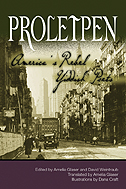
cover of Proletpen shows and old photo of an American city street Friends, readers, musicians in search of lyrics! Forgive the descent into self-promotion, but I have just gotten word from University of Wisconsin Press that Proletpen, America's Rebel Yiddish Poets will be offered in its attractive hardcover edition at only $26.99, down from its earlier $45 (it can also be purchased electronically for $16.95). I translated the 100 poems in this volume while I was in graduate school, and edited it together with David Weintraub of the Dora Teitelboim Foundation. The book is bilingual. It also features woodcuts by the illustrator Dana Craft. The historical introduction is by Dovid Katz whose father, the poet Meynke Katz, features prominently in the volume. Most of the poems here are from the 1930s, and most of the poets were fellow travelers (if not members) of the CPUSA, which means that there are love songs here to Lenin and red flags. But there are also love songs to people, and sad songs about war and the unforgiving city landscape.


The sentiments in these poems range from political alignment with leaders like Julio Melo and Anna Pauker to vitriolic criticism of the Party. In the five years since the book came out, I have come to see them as emotional documents that give us the tiniest glimpse into the fury of a strange, and often forgotten, episode in American history.

I have a fantasy that a musician will pick up this volume and put together an indie rock album based on these poems. Klezmer would also do nicely.

Monday, February 7, 2011

my enchanted contemporary

The same year I was born in California, Ëzhik was born in Moscow. Yury Norshteyn created him out of 2-dimensional cut-outs, entrusted him with a jar of raspberry jam, and lowered him into a foggy night. The little hedgehog embarks on a journey and gets terrifyingly, blissfully, lost. He encounters danger, love, regret, exhilaration, hopelessness, and finally, a peaceful acceptance of his fate, which (spoiler alert) carries him safely to his destination. I'm never sure when it will happen, but about once a year I pass through a week or two when I must watch Ëжик в тумане every night before falling asleep, in hopes, I guess, of dreaming about a white horse or a very tall oak.

Thursday, January 27, 2011

Ночь, улица, фонарь

I found this ad for Russia's MTS cell phone company on a search for Aleksandr Blok's 1912 "Ночь, улица, фонарь, аптека," and it warmed my Russophile heart. Here is the full poem:

    Ночь, улица, фонарь, аптека,
    Бессмысленный и тусклый свет.
    Живи еще хоть четверть века-
    Все будет так. Исхода нет.


    Умрешь - начнешь опять сначала
    И повторится все, как встарь:
    Ночь, ледяная рябь канала,
    Аптека, улица, фонарь.

I have taken much license with my translation:

    A night, a street, a streetlamp, drugstore,
    Unthinkable and fading light.
    Live but a quarter century more:
    Nothing will change. There's no way out.

    You'll die then start from the beginning,
    All the old patterns will repeat:
    The night, the canal's icy rippling,
    The drugstore, streetlamp, and the street.

The ad wouldn't work if 99% of it's viewers hadn't once been made to memorize this poem. A man is dictating Blok's famous words into his mobile phone, and the words float out into the night, finding their reflections in posters and ads around the city. But the resolution is tragic: the addressee is a student with a casually hidden ear bud. Instead of memorizing the poem, he has the technology to find it on the same streets that inspired Blok. Blok's poem will probably disappear from the storehouses of his readers' minds; but the lonely quotidian of a winter city night will remain. A night... a street... a cellphone... drugstore.

Thursday, January 20, 2011

eyes on eyes


St. Jerome called the face the "mirror of the mind." But Lev Kuleshov taught us that the mind being mirrored isn't necessarily the one attached to the face, but rather the one attached to the person observing and interpreting that particular face's expressions. In a short sequence from 1917-18, Kuleshov spliced close-ups of the popular character actor Ivan Mozzhukhin staring intently into the camera with alternating images of a bowl of soup, a child in a coffin, and a beautiful woman. The audience was thrilled by his portrayals of hunger, sadness, and lust: they didn't notice that the same footage of Mozzhukhin was repeated over and over. (The only version of this on the internet includes Spanish subtitles -- gracias to those who made it available!)

A few years earlier Mozzhukhin had played the devil in Starevich's 1913 adaptation of Gogol's "Night Before Christmas." Here is a Kuleshov test you can take at home: in this frame, is he:
a. hungry for a bowl of soup?
b. terrified that he will be beaten by an upstanding blacksmith?
c. craftily plotting to snatch the moon from the sky?
or d. with some careful montage, any of the above?


When I taught my Soviet film class in 2010, one of my students, Amanda Goodman, created her own Kuleshov experiment to successful effect. Rather than alternating between hunger, sadness, and lust, Amanda's protagonist is pictured observing a strip tease with apparently increasing interest. Her films have already screened at in the Sixth College UCSD Film Festival. Keep an eye out for this creative eye.

Friday, January 7, 2011

New Year's Furry Things

Youtube videos probably say at least as much about the late-night viewer as they do about the producer. This particular viewer is not quite ready to embrace her own strange fascination with Chai Vdvoem's New Year's furry things, the slender woman-with-a-key who rises like a yolochka toward her flat-screen TV, or the gogolian pig-demon the woman's lover for some reason sees fit to present her with. (Notice how the poor pig sniffs around the presents as if looking for a lost sleeve.) But I am posting this anyway, a placeholder for deeper thoughts on overturn... or at least a warm, fuzzy tribute to mandarin oranges and desire.


Netflix Files: The Man Who Cried

As far as I’m concerned there are 3 reasons one might spend a regrettable evening watching this movie. The first is Golijov's rather nice original score. The second is a brief sound cameo featuring my friend Jeremy exclaiming something in Yiddish from off-screen. The third is Cate Blanchett's wonderful, if somewhat anachronistic, portrayal of a Russian émigré. Blanchett's character is a masterful combination of desperate seductress, anti-Semite, and faithful friend. All of the other characters in the film are stiff, frankly offensive, caricatures. Christina Ricci who, miraculously rescued from a pogrom must sing her way to America to find her father (Oleg Yankovsky), plays a less human version of Feivel the Mouse from "An American Tale." Ms. Ricci, whose childhood alter ego is played by an undeniably cute Claudia Lander-Duke, utters a handful of lines throughout the entire film; what she does say is spoken without the least hint of expression. The doe-eyed gazes that the actress employed so brilliantly in Buffalo’66 simply do not work for this character. Johnny Depp's role as a gypsy horse-trainer is the stuff of bad porn. For a film with the word "cried" in the title, with the exception of Blanchett's aging Russian ballerina and the diva-breakdowns of John Turturro's fascist opera singer, any attempts at emotion are either misplaced, or simply unconvincing.

From the Netflix files: Russian Ark

Don't watch The Russian Ark [Russkii Kovcheg] (2002) for the plot (there isn’t a plot), or for the costumes (some appear to have been stolen from tourist-photo-op-actors on Nevsky). But Aleksandr Sokurov’s virtuosic single shot is pleasantly dizzying, and marks an important innovation in the cinematic portrayal of time and space. The entire film can be boiled down to the following: a whispering Marquis de Custine (Sergei Dreiden) with an unidentifiable European accent guides the viewer in an hour-and-a-half-long polonaise through various chapters of Russian history. By setting the entire film in St. Petersburg’s splendid Hermitage (the permission for which marks a heroic achievement in its own right), Sokurov likens his contemporary audience’s distant perception of history to a tourist’s first picturesque walk through a winter garden in bloom.

Monday, August 2, 2010

Demons on Governors Island

The August issue of Open Letters Monthly is now up. There is a lot of film and theater in this issue, in addition to its usual high-quality literary reviews and literature. I offer my assessment of Peter Stein's production of The Demons, a 12-hour performance on Governors Island a few weeks ago. I learned about the play from my friend Anne Eakin Moss, a Russian literature professor at Johns Hopkins. Anne offers her two cents, as well.

Friday, March 5, 2010

Announcing the Spring Russian Film Series at UCSD


U.C. San Diego's Program in Russian and Soviet Studies is pleased to present the Monday Evening Russian Film Series, Spring 2010

(Films will be shown at 7 PM, Center Hall, Room 214. All are open to the public.)


March 29: “The Extraordinary Adventures of Mr. West in the Land of the Bolsheviks” (Kuleshov, 1924) This satire about the United States' slanted view of the Soviet Union revolves around Mr. West, president of the YMCA, and what happens on his trip to the Soviet Union.

April 5: “Dersu Uzala” (Kurosawa, 1975) In 1902, a Russian army expedition is assigned to explore Siberia under the command of Captain Arseniev. He befriends the Goldi (Nanai) hunter Dersu Uzala and invites him to guide the explorers through the stark forest up to Khanka Lake.

April 12: “Three Songs About Lenin” (Vertov, 1934) Lenin, through the eyes of the Russian people, is represented by three songs. The first, "My face was in a dark prison," concerns the life of a young Muslim woman. "We loved him" deals with Lenin's life and death. The third song, "In a big city of stone," shows the accomplishments of his rule.

April 26: “The Circus” (Alexandrov, 1936) An American circus acrobat with a mixed-race child is indentured to a German ringmaster in exchange for keeping her secret. When the circus performs in the USSR, they are surprised to learn who is welcome and who is not.

May 3: "Cossacks of the Kuban" (Pyryov, 1949) This popular musical comedy is a love story based on a collective farm in the Kuban region.

May 10: “Ballad of a Soldier” (Chukhrai, 1959) With only a few days' leave from the front, a young hero connects with a number of others, all of whom are affected by his sincerity, simplicity, and love.

May 17: “I am Cuba” (Kalatozov, 1964) Four stories show the rise of the Communist revolution in Cuba. Battista's Havana and the poverty and oppression of the Cuban people

May 24: “My Friend Ivan Lapshyn” (German, 1984) A police investigator relentlessly and mercilessly pursues a gang of criminals, but comes to realize the distance between the idealism of the revolutionaries and the grim, frightening reality of the Stalinist era.

June 7: “Little Vera” (Pichul, 1988) A sullen, sultry teenager with few goals in life tries to deal with a brooding boyfriend, an abusive alcoholic father, an ineffectual mother and the futility of a life trapped in her small industrial town.

Thursday, November 19, 2009

vilde khaye


The domination and taming of childhood nightmares? A grown-up fetish? I haven’t read Dave Eggers' The Wild Things yet, nor have I made it to the recent Eggers'/Spike Jonze film collaboration… but Janet Potter's review in the current issue of Open Letters Monthly supports a suspicion I developed whilst spending several minutes in a bookstore last week stroking the luxury edition, which has a furry cover with creepy eyes: We may have an inkling as to where the wild things are, but we'll never know what they are. But we do have an idea about Max. Max is a kid, like us. With demons. A terrified kid who temporarily triumphs over his monsters, becomes one with them, tames them. And his dark world can also be hauntingly beautiful.


A current exhibit at the Contemporary Jewish Museum in San Francisco presents Maurice Sendak's art with an eye to his East European Jewish origins. In a compellingly candid interview with Bill Moyers, Sendak, whose mother called him Wild Beast ("Vilde Khaye") in Yiddish, admits that the wild things were modeled on his relatives, hairy immigrants who spoke poor English, would eat anything, and terrified the young, American children. "They have to know it is possible things are bad... but they are surrounded by people who love them." Of his 2003 collaboration with Tony Kushner, a retelling of the Holocaust opera, Brundibar, Sendak (his life partner was a psychoanalyst, after all) said, "you can't get rid of evil". To Catherine Keener, who plays Max's mother in Jonze's film, Sendak said, "Make it your own and don't pander to children. Be honest."

http://iconvsicon.com/wordpress/wp-content/uploads/2009/07/wildmax.jpg


Friday, October 9, 2009

if you let me keep my google books i promise to stop talking about it

Sergey Brin, cofounder of Google, published a good Op. Ed on the Google Books project in the New York Times today. I thought I'd take advantage of this forum to post my own letter to the editor, which appeared this week in the Chronicle of Higher Education (to view the complete discussion, you will need a Chronicle Account):


Anxiety about Google's library-digitization project has ranged from concern that it will rob authors of income to concern it will turn libraries into a capitalist enterprise. The U.S. Copyright Office fears that the settlement "alters the property interests of millions of rights-holders of out-of-print works without any Congressional oversight, and has the capacity to create diplomatic stress for the United States." Geoffrey Nunberg, in his recent essay ("Google's Book Search: A Disaster for Scholars,"The Chronicle Review,online edition, August 31), has suggested that Google's hasty, and monopolistic, digitization of books will yield a faulty catalog.
These fears must not bury an important breakthrough in offering old and rare books in an increasing number of languages and alphabets to those who cannot easily view them. The Copyright Office must take a stronger leadership role in making literary and scholarly work more, rather than less, visible in a virtual marketplace dominated by advertisements and instant publication. And the academic community must seek ways of helping Google to address our needs without undermining its efforts to adapt time-honored texts to a digital era.
For those who, like me, measure rooms in square feet of not floor space but wall space, Google Books helps to navigate an existing library. My own buying habits have increased with the online visibility of books' content. Since Google's Library Project was initiated in 2004, I have spent full evenings browsing new releases without leaving my living room. Intrigued by a new title? Left a book in my office and need a page number? Choosing what to assign next quarter? Check Google Books. Occasionally I find myself searching for an elusive page in a book that is sitting next to me.Published books are all too often eclipsed by unmediated, ephemeral, online literature; this is, unfortunately, apparent in the college literature classes I teach. Enabling Google's access to published material (and yes, in all editions) will ensure the relevance of the libraries of the past to the libraries of the future. Library digitization promotes intellectual engagement, even on a topic, or in a language, enjoyed by a minority. Just as I am able to browse early editions of 19th-century Russian literature, future readers may view my work long after its expected print life.
Like all teachers, I am wary of the dangers of misinformation, plagiarism, and perpetual distraction—dangers that the digital age did not invent, but that it hasn't eliminated either. In what some might call a reactionary gesture, I ban laptops in my classroom and require students to bring hard copies of their books to class and take notes by hand. The goal is to demonstrate the beauty of discussing literature across a table, of corresponding with writers of the past in the margins of their books while thinking slower than one can click.The libraries that have joined forces with Google have had the foresight to use paperless technology to reinforce a long literary tradition. Not only have they opened their holdings to a readership that could not otherwise reach them, they are stocking the world's virtual bookshelves with time-tested sources. When students leave my classroom, restart their computers, and curiously type a word into a search engine, they will retrieve not only encyclopedic definitions of dubious origin, but volumes that have been written and carefully edited since Gutenberg's remarkable 15th-century invention.Virtual media represents a new intervention, which brings with it new anxieties about the spread of text. But digital libraries spread texts worth reading.

Tuesday, September 22, 2009

manuscripts don't burn

My sabbatical is officially over. In a few days I will leave Harvard and its colossal Widener library, and return to San Diego, to my own books with my own handwriting in their margins, and to UCSD's Geisel library, a building named after Dr. Suess and made famous by Steven Spielberg, who inventively cast it as an alien spaceship in "Close Encounters of the Third Kind". UCSD's Slavic holdings are decent, and inter-UC loans are relatively fast, but they have nothing on Widener's Slavic collection, including the largest Ukrainian holdings outside Kyiv.

Happily, I get to take a lot of Harvard's library with me. And a lot of Stanford's, Michigan's and New York's libraries with me. And I can search their contents. In multiple languages. My greatest use of Google's digital library project over the past several months, as I have prepared my own manuscript for publication, has been checking page numbers and citations in older editions. A year or two ago this would have involved several trips to different libraries. Books that once would have taken weeks to arrive through interlibrary loan I can now download through "Полный просмотр". I have also used Google Books for hours of browsing (which inevitably leads to buying).

Some of my colleagues would question my optimism about Google, a company that, doomsayers warn us, threatens to track our whereabouts and digitize our daydreams. But Google's aspiration toward omniscience and creative experimentation with organizational algorithms promises to make literary texts accessible to a vast population of readers in the United States and abroad.

In a few weeks a "fairness hearing" will assess the settlement Google Books has reached to ensure publishers and authors adequate compensation. I will be relieved when this date has passed and I am assured continued access to Google's digitized treasures. In the mean time, I will return to my office in San Diego and unpack my own library. And in the process I will unearth the old xeroxed copy of Walter Benjamin's 1931 "Unpacking my Library" I once absentmindedly stuck between a couple of volumes while in college, and which has remained a kind of inside joke with Benjamin as I have packed and unpacked it with my books ever since. "I am unpacking my library. Yes, I am. The books are not yet on the shelves, not yet touched by the mild boredom of order." (Benjamin, "Selected Writings, V. 2," Cambridge, MA: 1999, 486)

(I am not yet home with my boxes and shelves, and therefore have yet to unpack my old copy of this essay; I looked this passage up on Google Books.)


Update: For a collective discussion of this issue, see my and others' notes to the editor in the Chronicle of Higher Education.

Thursday, September 10, 2009

thoughts on the eve of a new school year


This summer I had the weird sensation of watching debates about University budget cuts and furlough plans from the other side of a looking-glass. In Petersburg, conversations about my state (California) and its economy (bankrupt) with Russian colleagues left me with a mixture of sheepishness and foreboding. Who am I to complain about an 8% salary cut when I still travel, have benefits, food and clothing without taking a second or third job? On the other hand, the measly resources allocated to a once thriving Russian academy might serve as a cautionary tale. The collapse of the Soviet Union two decades ago held enormous potential for new forms of intellectual engagement. But education has been lost in the shuffle of a tumultuous market. Academics have seen travel and research budgets disappear. A Petersburg mathematician remarked to me, “Neighbors used to respect teachers and scholars. They were curious about what we did, what books we had. Now that they make ten times our salary they pity us and we envy them.” While no self-respecting academic would expect the deference of their neighbors, the fact that educators are now viewed not only as idiosyncratic, but even as foolish, reflects a changing cultural priority. Many Russian professors conduct their research at home, traveling to campus only to give lectures because public universities cannot afford office space or staff. Their most famous colleagues have gone overseas and their brightest students are tempted away by far more profitable, far less thoughtful or intellectual, careers. A growing number of college students did not score in the top percentile of the applicant pool but were accepted based on their ability to pay higher tuition.


Education is not a luxury. It is our right to live in a literate state among citizens who adapt easily to new technology and are inspired to enter medical and research fields. It is our right to live among people who think critically and creatively. It is our right to be curious about world history, politics and culture. Today each UC student, parent and employee might be prepared to absorb what has been called a “shared sacrifice”, but the entire state will feel the total loss of educational resources. We don't need a sharing of sacrifices but a readjustment of priorities. California must do everything it can to raise its educational standards. It is too easy to grow accustomed to lowering them.